
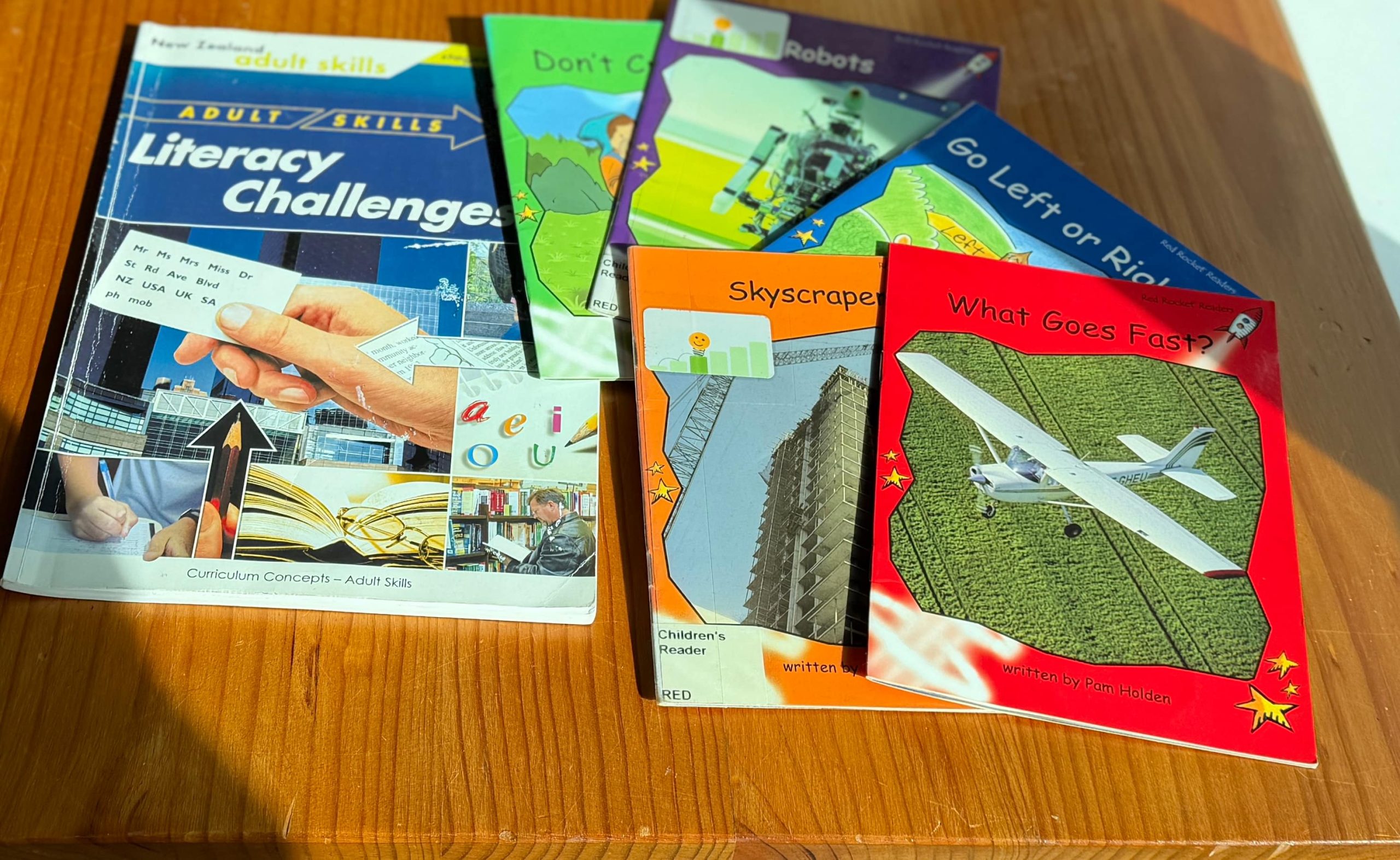
Literacy in prisons can be the start of a new personal identity, writes Helena Easton.
A young tāne caught up in the justice system said he “just wanted some help with his reading”. But something clicked, and he got hooked on learning and didn’t want to stop.
The education team at his site got him enrolled with Te Kura. Then a Howard League volunteer stepped in, working with him one-to-one, cheering him on, keeping him on track, and backing his goal to finish NCEA.
Bit by bit, assignment by assignment, he built up momentum. And in time, that young man came out the other side with NCEA Level 1 and Level 2.
Stories like this matter because they show what education can do inside prisons, youth justice facilities and for people on probation.
“Literacy and learning are not add-ons for people in prisons. They are foundational.”
Literacy is not only about reading a worksheet or filling in a form. It can be the start of a new personal identity: I am someone who can learn. I am someone who can finish things. I am someone with options.
Literacy and learning are not add-ons for people in prisons. They are foundational. They can help people engage more confidently with training, employment, whānau life, and life after release. They can also open the door to something deeper and more lasting: becoming a lifelong learner.
Why literacy matters in prison settings
Many people in prison have had difficult experiences of education long before entering custody. Some left school early. Some were never well served by mainstream schooling. Some live with learning differences, communication difficulties, trauma, disrupted schooling, or a long history of being told – directly or indirectly – that learning is not for them.
That makes literacy support especially important.
If reading, writing, speaking, listening, and numeracy are shaky, almost every other step becomes harder. Completing a qualification becomes harder. Succeeding in vocational training becomes harder. Navigating forms, timetables, rules, and official systems become harder. Holding onto confidence becomes harder too.
Research in New Zealand and overseas has long pointed to the same conclusion: low literacy is overrepresented in prison populations.
Stronger educational support can improve engagement, behaviour, employability, and post-release prospects. Low literacy is a practical barrier in prison-based training and qualification settings, including for learners who could do the job, but struggled with the reading and writing required for assessment.
That does not mean literacy challenges define a person. It means that when support is available, well-delivered, and sustained, literacy can become a lever for change.
Literacy in prison compared with the general population
In the general New Zealand adult population, the OECD’s 2023 Survey of Adult Skills found that 26% of adults aged 16-65 scored at Level 1 or below in literacy, meaning they have low literacy proficiency. New Zealand’s average literacy score was close to the OECD average.
Inside prison, the picture is much more challenging.
Ara Poutama Aotearoa/Department of Corrections says in its annual 2024-5 report that about 10% of people in prison need intensive literacy and numeracy support. Elsewhere, Corrections has suggested that many people in prison have only primary school levels of literacy and numeracy.
“The most powerful thing about prison education is not only that people gain skills. It is that they can begin to imagine a different future for themselves.”
These statistics should be used with care, and greater detail is needed. Even with that caution, the broad comparison is clear: literacy need is far more concentrated inside prison than in the wider population.
That gap matters. It means prison education is not just a useful service for a few people. It is core infrastructure for opportunity, participation, and rehabilitation.
How does Aotearoa New Zealand compare?
New Zealand imprisons more of its people than most countries we usually measure ourselves against.
The World Prison Brief records 11,256 people in New Zealand prisons as at 30 June 2026. That is a rate of 210 per 100,000 people.
Compare that to Australia’s rate at 170. It’s lower in England and Wales (136) and lower still in Norway at 54 and Finland at 58.
Also the direction of travel in this country is up again. New Zealand’s imprisonment rate was 148 per 100,000 in 2000. It climbed to a peak of 214 by 2018, fell sharply to 150 by 2022, and has now returned to 210.
That means the number of people in prison needing literacy and learning support is quickly growing again.
But there’s another figure that deserves more attention than it usually gets.
Remand prisoners, that is people incarcerated before sentencing, now make up 41% of New Zealand’s prison population. In 2000 they made up 13.3%. In 2010, 21.6%.
The population needing literacy support is growing fastest in the part of the system least able to provide it.
This is a significant challenge for education. People on remand often have uncertain timeframes, frequent court movements, and limited eligibility for programmes. Sustained, structured learning is hardest to deliver exactly where the population is expanding fastest.
Any serious conversation about prison education in Aotearoa has to reckon with that.
The same pattern shows up overseas
New Zealand is not unusual in having high literacy needs inside prisons. Every comparable jurisdiction reports something similar.
To take two examples.
In Australia, 31% of prison entrants report Year 9 or below as their highest level of completed schooling, and 13% report Year 8 or below. For First Nations entrants that second figure rises to 24%, and 54% of all entrants arrive with no qualification beyond school.
In Norway, half of all prisoners have primary education as their highest level of attainment, compared with around 27% of the general population. Thirty percent report reading and writing difficulties.
But Norway offers a different model from Aotearoa. Since 1969, prison education has been delivered by the mainstream school system under education law. The Ministry of Education holds professional and financial responsibility rather than the justice system. So although the need remains high, the main barrier reported by Norwegian prisoners is a different one: waiting for a place on a course
The figures might differ but the pattern is consistent. Prisons concentrate educational disadvantage.
Education as a corner-turning opportunity
The most powerful thing about prison education is not only that people gain skills. It is that they can begin to imagine a different future for themselves.
A learner may come into custody with low confidence, patchy schooling, and a belief that education belongs to other people. Then someone helps them decode a text, write a paragraph, understand instructions, or persist with a course long enough to pass. From there, something important can happen: the learner starts to experience success.
That success may begin with the basics: reading more fluently, writing more clearly, managing numbers with less fear. But it often does not stop there. Once the foundation is in place, learners can move into NCEA, vocational learning, distance education, workplace training, or personal-interest study. They are no longer only catching up. They are moving forward.
This is why literacy should be seen not as remediation in a narrow sense, but as identity-building work. A person who has repeatedly experienced failure can, through education, start to develop a new story about themselves:
- I can learn.
- I can ask for help.
- I can stick at something difficult.
- I can achieve recognised qualifications.
- I can keep learning after release.
That is a genuine corner-turning opportunity.
Respecting the work already done
Any honest account of literacy and learning in New Zealand prisons should acknowledge the substantial work already delivered by Corrections staff, education teams, teachers, external providers, and volunteers.
Prison education happens in a highly structured environment, often with logistical, security, staffing, and operational constraints that people outside the system do not always see. Delivering meaningful learning under those conditions takes commitment and skill. It also takes partnership.
Across the system, learning support may involve site education teams, contracted providers, literacy and numeracy specialists, cultural programmes, vocational tutors, case managers, distance learning pathways, and community-based organisations that continue support after release.
In some cases, volunteers make a distinct contribution by offering consistent one-to-one encouragement that helps a learner stay engaged long enough to succeed.
That ecosystem matters. One provider may help with foundational literacy. Another may open the pathway to formal qualifications. A site team may arrange enrolment. A volunteer learning mentor may provide the human connection that keeps motivation alive.
The result is not simply course completion. It is a supported learning journey.
From literacy support to lifelong learning
For some learners, the first win is modest but meaningful: finishing a workbook, reading a letter independently, or writing with greater confidence. For others, the next step is a formal qualification, NCEA or vocational or academic study. For others again, the real breakthrough is not the certificate itself but the formation of a new habit: continuing to learn.
That shift toward lifelong learning is one of the most hopeful outcomes in prison education. It means the learner is no longer engaging only because a programme is offered. They are choosing education as part of who they are becoming.
This matters after release as much as during imprisonment. A person who sees themselves as a learner is better positioned to:
- enter further education or industry training
- engage more effectively in employment
- build confidence in official and workplace settings
- support their children or whānau with learning
- navigate everyday life more independently
The value of literacy, then, is both practical and personal. It improves access to opportunities, but it also reshapes self-belief.
The New Zealand context: promise and unfinished work
New Zealand’s wider literacy picture gives useful context. The OECD found that 26% of adults aged 16-65 in New Zealand have low literacy proficiency, and among 16-24 year olds, average literacy performance was below the OECD average.
That tells us two things. First, literacy challenges are not confined to prisons; they are present across the wider community. Second, prison education sits within a larger national challenge around educational equity and adult learning.
At the same time, prison settings concentrate that need more intensely.
Research on prison education in New Zealand has documented the practical reality that some prisoners are capable in hands-on work but struggle to meet written assessment demands without support.
More recent scholarship has also noted the difficulty of establishing and sustaining higher education pathways for incarcerated learners in Aotearoa New Zealand, even where there is strong interest and clear potential.
That combination of high learner need, real operational barriers, and strong potential gains is exactly why prison education deserves serious public attention and support.
What effective support can look like
There is no single model that works for every learner, but several themes come through consistently.
Foundational literacy first
If someone cannot comfortably read instructions, understand assessment tasks, or express themselves in writing, higher-level learning will often remain out of reach. Strong basic literacy and numeracy support creates the platform for everything that follows.
One-to-one encouragement matters
Many learners in prison have had fractured or painful educational histories. Personal encouragement can make the difference between dropping out and persisting. A trusted mentor or tutor can help normalise struggle, celebrate progress, and make achievement feel possible.
Clear pathways matter
It is easier for learners to stay motivated when they can see the next step: from foundational support to NCEA, from NCEA to vocational training, from vocational learning to further study or employment planning. Momentum grows when learning feels connected rather than fragmented.
Recognition matters
Achieving a real qualification matters symbolically as well as practically. It tells the learner – and others – that this effort counts. Certificates do not tell the whole story, but they do mark progress in a tangible way.
Respect matters
Adult learners in prison should be treated as adults with potential. Respectful, culturally responsive, strengths-based practice helps people stay engaged and believe that learning belongs to them too.
Why this work deserves support
People interested in supporting learning inside the wire are often motivated by both compassion and pragmatism. Education is humane, but it is also practical. It improves skills people need in everyday life. It strengthens access to training and work. It can support healthier identity formation and better future choices.
There is also a wider social benefit. When people leave prison with stronger literacy, more confidence, and recognised learning behind them, the benefits do not stop with the individual. Whānau, employers, communities, and future educators all feel the effect.
Volunteering in this environment is demanding. Progress is sometimes uneven. Learners may have interruptions, setbacks, or competing pressures. But none of that undermines the value of the work. If anything, it underlines why patient, well-coordinated support matters so much.
A hopeful way to talk about prison learning
The best way to talk about literacy in prison is honest and hopeful.
The honest part is this: literacy need inside prison is significant, and far higher than in the general population. The hopeful part is this: people can and do make real educational progress, especially when foundational support, formal pathways, and human encouragement come together.
That is why our opening story of the young man who moved from reading support to NCEA Level 2 is so important. It is not only a success story. It is an example of what becomes possible when someone is given the chance to build a new relationship with learning.
Education is key because it does more than transfer knowledge. It creates movement. It helps turn a closed story into an open one. And inside the wire, that can be the beginning of everything.
