
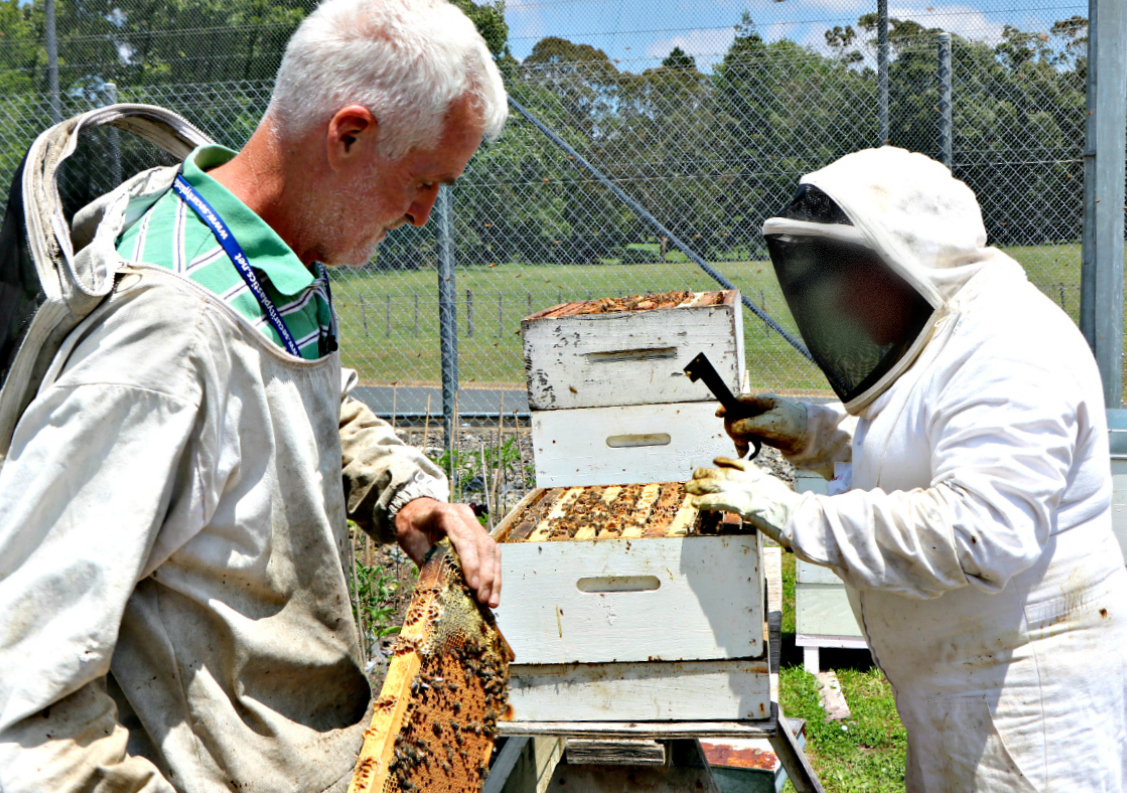
For more than a decade, Brian Alexander has driven to two Auckland prisons to teach beekeeping. Hundreds of students have come through his classes. We sat down with him to talk about hives at midnight, teaching people who learn by doing, and why a matchbox left in a bee suit pocket tells you almost everything.
When did you get into beekeeping with the Howard League?
I think it was 2013 or 2014.
What made you offer beekeeping as an occupation for people in prison? Was it your idea?
It wasn’t, no. [Former New Zealand Howard League Patron] Tony Gibbs was developing an avocado orchard at Tāpora and he rang up for some advice. The next step was volunteering, teaching beekeeping.
First of all we tried at Paremoremo, and we didn’t really get a great reception. So Tony said, oh, we’ll go down to the women’s prison at Wiri, and they said yes straight away. So I started at Wiri, and that was going really nicely, and then suddenly Paremoremo got back to Tony to say, yeah, we would be keen. So I went to two prisons.
It wasn’t just me. Tony was an inspirational man. He could talk and he could persuade. And I just said, oh, let’s give it a go.
What were your first steps once you had the go-ahead?
Well, we went down to have a look to see if we could put hives into the prisons. That’s a story in itself, because hives can only be shifted at night.
When I went to Wiri I said, I’ll have to do it at night. So you have to go through the sally port, and that was unheard of at night. And I said, I’d like the ladies there to help me unload – that was also unheard of. But I got through the sally port and the ladies were out there unloading the hives. If you’re going to do beekeeping, that’s how you do it.
At Paremoremo it was different, because they’re in the outside units, not the main block. I just came in at night, and there was one officer on duty because everyone’s locked down, and I unloaded them myself.
Was there a lot of enthusiasm to join up?
We’ve never had vacancies. The wardens know who to ask, and a lot of the students ask to be part of it. When we start a new class the word just gets spread. Some try it and don’t like it, and that’s fine – someone else takes their place. But prison’s pretty boring, and I tend to have students who’ve got their act together. They’re motivated and want to learn, and doing something like this helps them at parole too.
“I can’t say I’ve ever had a student I didn’t like. Everyone I’ve met, you can see potential in them.”
How many in a class?
Six to eight, at both prisons. I meet them first so they get to know each other, because we try to run the course over a whole year – that’s the whole season. We’ve done both Level 2 and Level 3 beekeeping, so a student who chooses to do Level 3 will end up doing two years of beekeeping.
What’s their reaction when they start? Most of them wouldn’t know anything about bees.

They’re very happy. A lot of them are really scared of bees flying around, and then they open their hives for the first time and it’s not a horror story at all. They see the bees, they start seeing this and that, and suddenly, it’s all right.
Do you see people change over the course?
That’s too hard for me to say, because most of the students are doing other courses as well, addressing whatever their offending was. So the change is coming from a lot of places. But I can’t say I’ve ever had a student I didn’t like. Everyone I’ve met, you can see potential in them.
Were there challenges, working inside?
Not really. You just go in and teach, because you’re only there to teach beekeeping. So it’s easy. Sometimes you can upset someone without realising it – not very often – so you’ve got to be a bit sensitive to some things, and then you just say sorry.
You were trained as a teacher, weren’t you?
Way back, yes, and I hated it. Mathematics. But teaching kids mathematics at school and teaching prisoners beekeeping, there’s no comparison.
You do have to learn how to teach beekeeping, though. You can’t just do the same thing for everyone. You’ve got to make it suitable for each student. Some of them have got university training and others haven’t passed a test ever. So you’ve got to mix it up. For the sharper ones you’ve got to keep the challenge there, and that’s usually not on the practical side, it’s the academic side – because on the practical side they’ll often all get there.
I’ve used a lot of mentoring too. Some of the older students I’ll ask to come back and help mentor the group. You might have six hives open and I can’t keep an eye on everyone, but my mentors can teach the others. I do it because I think mentoring is an important skill to learn. They don’t know what their future’s going to be, but if they’ve helped somebody with something, that’s a really positive thing to come away with.
What does a typical session look like?
If we’re doing practical, we’ve got eight to ten hives there. We light the smokers, put the bee suits on, and whatever needs doing to the hives, they’ll do. But these are teaching hives, so we’re looking at them intensely every week. Commercially you might open a hive every three or four weeks. It’s not great for the hives, pulling them apart like that. We sacrifice the hives for the teaching, and I’m quite open about that, because the only way you get reasonable beekeeping skills is by practising.
What surprised me is how quickly a lot of them get good. After about six weeks most of them can inspect brood, assess a hive, find queens pretty easily. Repetition makes you better. It’s like writing stories: you look at your first one and hopefully you’ve improved.
“For a few of them it’s the first test they’ve ever passed.”
And the written side?
A lot of the Level 3 material is designed to be done online, which they can’t do. Once SIT and Telford knew my background they were happy for me to sign off and mark the courses. So we sit down with the assignments. At Wiri that’s a container that doubles as a lunch room, at Paremoremo it’s the lunch room by the nursery.
Some of them aren’t quite there with reading or writing, so you sit down and work through it. For a few of them it’s the first test they’ve ever passed. I don’t think I’ve had a student who hasn’t said, I learn by doing, not by reading. And then we sit down and they read and they learn too, and that’s preparation for being able to pass tests later on. Even the Howard League driver’s licence, you’ve got to sit down and do a bit. So that scary moment of actually sitting a test, they’ve done it before somewhere, and doing it again isn’t so difficult.
Are there other benefits beyond the bees?
The group ends up being quite tight. They’ve got bees as a common language, and I see that a lot. Even just for a year. But then they realise you can get that same feeling from joining a club or a sports team.
We give each other a hard time, too. I just regard it as a workplace. In commercial beekeeping you might be two metres away from each other in your bee suits, but you’re always talking about something.
Is it different teaching the men and the women?
For the last few years at Paremoremo it’s been the special treatment unit, and they’re really easy. They’ve usually been in prison quite a while by that stage, they really want to get out, and they’re quite even emotionally. The courses they do there are very intense and they go right back to the cause of their offending. I’ve had students say, look, I can’t come today, it’s been too intense. You just respect that.
Some of the women are still all over the show. Most of them are spot on, but there’s always a few still working through their issues. And often the women are doing the beekeeping not at the end of their sentence. They could still be on remand, court cases haven’t come up. So it’s not really a fair comparison, they’re at different stages.
What about the staff?
The staff I deal with are usually very, very good, really spot on. And I’m probably privileged in the staff I deal with, so it’s not a true reflection of everybody. But they respect the work because they know I’ve got no agendas. I’m not there to reform Corrections. I’m just there to teach beekeeping.
There’s a lot of trust involved. Beekeeping equipment includes things you don’t normally take into a prison. I have to light smokers, so at Wiri that’s all kept under lock and key. Not long ago I went to do some beekeeping and my matchbox wasn’t in the dashboard where I keep it. It had ended up in the pocket of one of the bee suits, and the guy gave it back to me the next week. They know that if things get stuffed up, the beekeeping might stop. They really respect that.
Did you ever get to take people outside the wire?
We did quite a bit of that at Paremoremo at one stage, taking the guys out to do more beekeeping. It did them so much good. Corrections won’t have a bar of it now. I think they’re risk-averse.
We’ve had one or two outside the wire at Wiri, but that’s really difficult. One of my students was involved with a conservation group working on cleaning up the waterways, and she got me involved with that group, so I could take her out to help them with their beekeeping. She’s still in contact with them.
I used to be able to take guys out almost weekly. One went out with me twenty-five times. Another only went out a few times before he was released. I’d pick him up in the ute and we’d go through the checkpoints, and once we were a kilometre down the road he said, can I wind the window down? I just want to feel the fresh air on my face.
Any particular success stories?
The thing I enjoy most is the enjoyment they get from it. I’ve had comments several times. They say, when we’re beekeeping, I’m not in prison anymore. How can you beat that?
There’s a documentary being made about beekeeping in prisons. Peter Day’s been working on it for nearly four years now, following two of my students. One of them has come out and is blossoming, she’s got a full-time job at the City Mission. And another guy who, basically, the system failed.
A couple have gone on to beekeeping properly. One guy’s got a full-time job as a beekeeper, and one of the women is trying to. Others just keep a couple of hives in the backyard. I keep in contact with a few, and quite often when someone’s first released, because that first year or two is really difficult, if they live locally they’ll come out beekeeping with me for the day. A lot of them have still got their bracelets on, so it’s an excuse to get out. That’s all cleared through Probation. I give them a list of the addresses we’re going to, because they have to be approved.
Do I think the beekeeping keeps people out of prison? Most of the ones I deal with I don’t think will go back. But I’m pretty sure the beekeeping hasn’t done that on its own. It probably hasn’t been a hindrance, either. I just think a lot of things together can help.
Has it changed you?
Of course. You’re meeting people from all sorts, and anything like that changes you. When you’re getting older, meeting new people gets more difficult, so I mean a lot more to me than it might sound.
Beekeeping itself changed me long before that. When my boss first opened a hive and I saw the bees, I thought: that’s the rest of my life. I knew beekeeping would be forever. Even now, at my age, if I feel shitty I’ll go and do some beekeeping.
Are you still going?
I’ve finished at Wiri as we’ve got replacements there. I’m still going at Paremoremo because we haven’t got replacements yet, and I’ve told Helena [Easton, Volunteer Programme Manager], I’ll keep everything going until we do. Two people have started, so the programme will continue.
Could it expand to other prisons?
Helena’s looking at that. When we needed replacements at Wiri we went to the local bee club and got a response, so I said, well, we could go down to Hamilton and see what we get. There has been beekeeping at other prisons over the years: Ngāwhā, Spring Hill. One student came from Spring Hill to Paremoremo and wanted to rejoin just to keep the beekeeping going, and I was impressed with his knowledge. Whatever he’d been taught was spot on.
Please consider donating if you would like to support programmes like beekeeping